


 https://www.scieneers.de/wp-content/uploads/2026/08/Gemini_Generated_Image_rg6ongrg6ongrg6o-1-scaled.jpeg
1429
2560
shinchit.han@scieneers.de
https://www.scieneers.de/wp-content/uploads/2020/04/scieneers-gradient.png
shinchit.han@scieneers.de2026-09-02 09:00:072026-09-04 09:32:15Data Product Ownership
https://www.scieneers.de/wp-content/uploads/2026/08/Gemini_Generated_Image_rg6ongrg6ongrg6o-1-scaled.jpeg
1429
2560
shinchit.han@scieneers.de
https://www.scieneers.de/wp-content/uploads/2020/04/scieneers-gradient.png
shinchit.han@scieneers.de2026-09-02 09:00:072026-09-04 09:32:15Data Product OwnershipEin Buchstabe, der alles verändert
Die Geschichte der Sichelzellkrankheit
In unserem Beitrag Die Nadel im genomischen Heuhaufen finden haben wir beschrieben, wie sich eine einzelne genetische Variante zwischen Millionen harmloser Varianten im menschlichen Genom verstecken kann.
Manchmal wissen wir jedoch bereits ganz genau, welche Variante eine Krankheit verursacht.
Die Sichelzellkrankheit ist eines der bekanntesten Beispiele dafür.
🧪 Die Mutation hinter der Krankheit
Die Sichelzellkrankheit wird durch eine Mutation im HBB-Gen verursacht, das für das Beta-Globin-Protein codiert, einen zentralen Bestandteil des Hämoglobins.
Hämoglobin ist für den Sauerstofftransport in unseren roten Blutkörperchen verantwortlich.
In diesem Fall verändert der Austausch eines einzigen Nukleotids eine einzelne Aminosäure im Protein: Aus Glutaminsäure wird Valin.
Das klingt nach einer winzigen Veränderung.
Doch dieser eine Austausch verändert die physikalischen Eigenschaften des Hämoglobins. Unter bestimmten Bedingungen lagern sich die mutierten Hämoglobinmoleküle aneinander und bilden lange Fasern im Inneren der roten Blutkörperchen.
Dadurch werden die Zellen, die normalerweise rund und flexibel sind, starr und nehmen eine sichelförmige Gestalt an.

KI-generierte Illustration der Sichelzellkrankheit in einem Blutgefäß: sichelförmige rote Blutkörperchen verklumpen und blockieren den Blutfluss, während normale runde rote Blutkörperchen das Gefäß passieren.
🩸 Warum die Form entscheidend ist
Diese verformten Zellen können kleine Blutgefäße verstopfen und zerfallen leichter.
Die Folgen sind gravierend: Schmerzkrisen, eine verringerte Sauerstoffversorgung, Organschäden, ein erhöhtes Infektionsrisiko und eine verkürzte Lebenserwartung.
Obwohl die Sichelzellkrankheit in Europa als selten gilt, ist sie in Teilen der Subsahara Afrikas deutlich häufiger. (Quelle: WHO)
Der Grund dafür ist ein bemerkenswertes Beispiel für einen evolutionären Trade-Off.
🌍 Die Verbindung zur Malaria
Die Sichelzellkrankheit wird autosomal-rezessiv vererbt. Das bedeutet: Nur wer zwei Kopien des mutierten Gens erbt, erkrankt.
Menschen, die lediglich eine Kopie tragen, sogenannte Träger, sind dagegen deutlich besser vor schweren Malariaverläufen geschützt. (Quelle: Sickle cell anaemia and malaria)
Dieser Schutzeffekt verschaffte Trägern in Regionen mit endemischer Malaria einen Überlebensvorteil.
Über Generationen hinweg führte das zu einer höheren Häufigkeit der Mutation in diesen Bevölkerungsgruppen.
Heute werden schätzungsweise 515.000 Kinder pro Jahr mit einer Sichelzellkrankheit geboren, viele davon in Subsahara-Afrika. (Quelle: WHO)
In einigen Regionen sterben 50–90 % der betroffenen Kinder, bevor sie das Erwachsenenalter erreichen. (Quelle: The epidemiology of sickle cell disease in children recruited in infancy in Kilifi, Kenya: a prospective cohort study)
🧬 Die Mutation beheben
In vielen meiner Vorträge kommt immer wieder dieselbe Frage auf:
Wenn wir die genaue Mutation kennen, die eine Krankheit auslöst, können wir sie dann nicht einfach reparieren?
Bei Erkrankungen, die auf einem Einzelbasenaustausch beruhen, ist dieser Gedanke besonders naheliegend. Wenn ein einziger Buchstabe im Genom die Krankheit verursacht, könnte die Korrektur dieses Buchstabens das Problem im Prinzip vollständig beseitigen.
Lange Zeit klang das eher nach Science-Fiction als nach Medizin.
Doch im vergangenen Jahrzehnt hat eine Technologie das grundlegend verändert: CRISPR-Cas9.
2020 wurde Emmanuelle Charpentier und Jennifer Doudna der Nobelpreis für Chemie für die Entwicklung dieser revolutionären Genome-Editing-Methode verliehen. CRISPR erlaubt es, DNA an einer präzise definierten Stelle zu schneiden und die Sequenz zu verändern und eröffnet damit die Möglichkeit, krankheitsverursachende Mutationen direkt zu korrigieren. (Quelle: The Nobel Prize)
Die Sichelzellkrankheit ist eines der ersten Beispiele, bei denen diese Idee von der Theorie in die klinische Praxis übergegangen ist.
Die erste CRISPR-basierte Therapie gegen die Sichelzellkrankheit, Casgevy, ist bereits zugelassen. (Quelle: FDA)
Allerdings kostet die Behandlung derzeit rund 2,2 Millionen US-Dollar pro Patient:in. (Quelle: Affordable Pricing of CRISPR Treatments is a Pressing Ethical Imperative)
🇮🇳 Ein anderer Ansatz
Vor zwei Jahren hatte ich die Gelegenheit, an einem Workshop am CSIR-IGIB in Neu-Delhi teilzunehmen, wo ich Dr. Debojyoti Chakraborty kennenlernte.
Debo war unglaublich zuvorkommend und nahm sich die Zeit, uns herumzuführen und seine Arbeit ausführlich zu erklären.
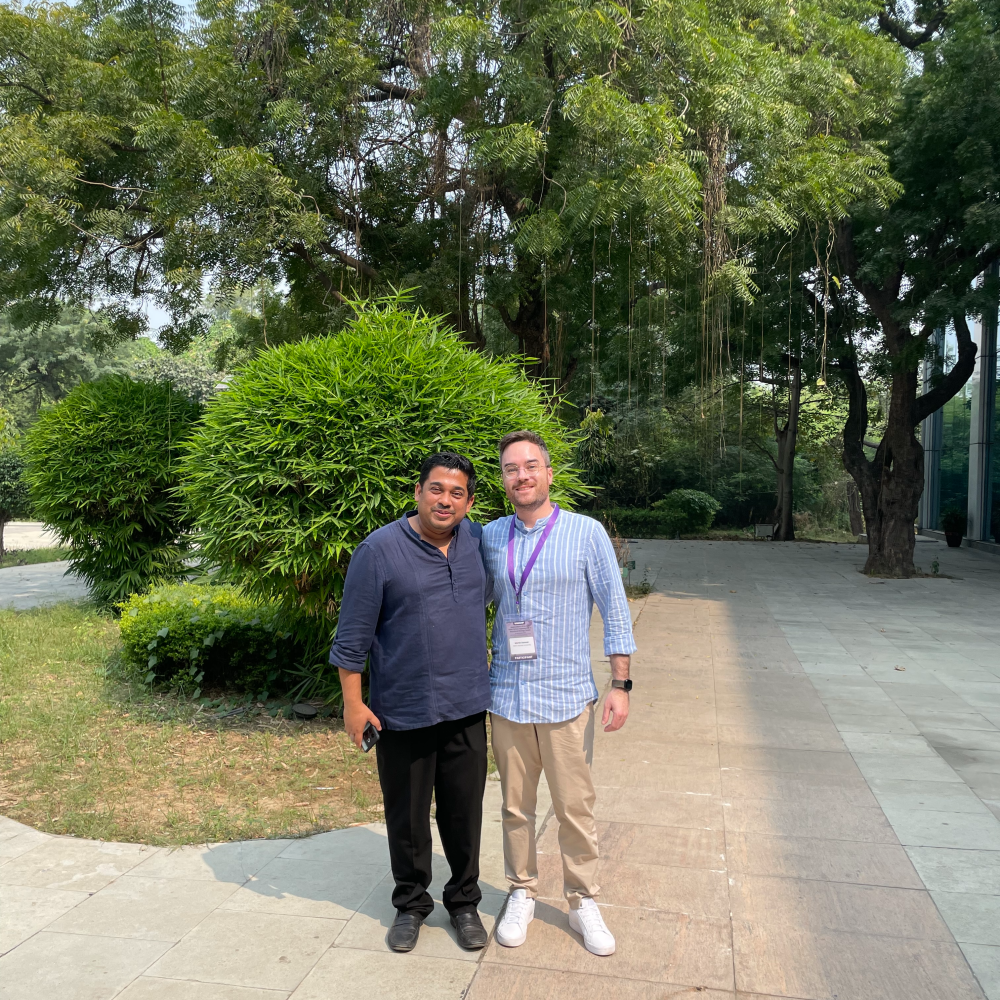
Foto von Dr. Debojyoti Chakraborty und mir vor dem Gebäude des CSIR-IGIB (Institute of Genomics and Integrative Biology) in Neu-Delhi während eines Workshop-Besuchs.
Es war eine dieser Begegnungen, an die man sich noch Jahre später erinnert.
Falls du das hier liest, Debo, nochmals vielen Dank für diese Erfahrung. 🙂
Gemeinsam mit seinen Kolleg:innen entwickelt er eine CRISPR-basierte Therapie namens Birsa-101, die die Sichelzellmutation korrigieren soll. (Quelle: Birsa-101: India’s Path Towards Affordable CRISPR Therapies)
Die Therapie befindet sich derzeit in klinischen Studien und soll die Behandlungskosten drastisch senken, möglicherweise um bis zum 40-Fachen.
Das Projekt ist Teil der 2023 gestarteten National Sickle Cell Anaemia Elimination Mission Indiens, die das Ziel verfolgt, die Krankheit in Indien bis 2047 zu eliminieren.
Wer tiefer in die Technologie und Debos Forschung eintauchen möchte, dem empfehle ich das folgende, in Nature Communications erschienene Paper: PAM-flexible Engineered FnCas9 variants for robust and ultra-precise genome editing and diagnostics
🔬 Von der Variante zur Heilung
Für mich hat diese Erfahrung eines sehr deutlich gemacht:
Ein einziger Buchstabe im Genom kann eine verheerende Krankheit auslösen.
Aber das Zusammenspiel von Genomik, Biotechnologie und zunehmend auch Machine Learning könnte es uns ermöglichen, ihn zu korrigieren
Unser Beitrag
In unserer gemeinsamen Forschung mit dem Zentrum für Humangenetik und Genommedizin der Uniklinik RWTH Aachen entwickeln und wenden wir Machine Learning Methoden an, um neue Erkenntnisse aus genomischen Daten zu gewinnen und so zu einer besseren Versorgung und Behandlung von Patient:innen beizutragen. Darüber hinaus betreuen wir die Cloud-Infrastruktur und die Data-Lakehouse-Architektur, die skalierbare genomische Datenanalysen in Kombination mit modernsten ML-Ansätzen möglich machen.
Wenn dich diese Arbeit interessiert oder du über mögliche Kooperationen sowie Projekte sprechen möchtest, melde dich gerne bei uns oder direkt bei mir.
Autor
 https://www.scieneers.de/wp-content/uploads/2026/08/Gemini_Generated_Image_rg6ongrg6ongrg6o-1-scaled.jpeg
1429
2560
shinchit.han@scieneers.de
https://www.scieneers.de/wp-content/uploads/2020/04/scieneers-gradient.png
shinchit.han@scieneers.de2026-09-02 09:00:072026-09-04 09:32:15Data Product Ownership
https://www.scieneers.de/wp-content/uploads/2026/08/Gemini_Generated_Image_rg6ongrg6ongrg6o-1-scaled.jpeg
1429
2560
shinchit.han@scieneers.de
https://www.scieneers.de/wp-content/uploads/2020/04/scieneers-gradient.png
shinchit.han@scieneers.de2026-09-02 09:00:072026-09-04 09:32:15Data Product Ownership https://www.scieneers.de/wp-content/uploads/2026/08/Gemini_Generated_Image_fb66safb66safb66-scaled.png
1429
2560
Alina Dallmann
https://www.scieneers.de/wp-content/uploads/2020/04/scieneers-gradient.png
Alina Dallmann2026-08-12 18:21:492026-08-14 15:50:16Spec-Driven-Development
https://www.scieneers.de/wp-content/uploads/2026/08/Gemini_Generated_Image_fb66safb66safb66-scaled.png
1429
2560
Alina Dallmann
https://www.scieneers.de/wp-content/uploads/2020/04/scieneers-gradient.png
Alina Dallmann2026-08-12 18:21:492026-08-14 15:50:16Spec-Driven-Development https://www.scieneers.de/wp-content/uploads/2026/07/story_sickle_cell_no_title.png
1024
1536
Martin Danner
https://www.scieneers.de/wp-content/uploads/2020/04/scieneers-gradient.png
Martin Danner2026-07-08 17:14:282026-07-31 14:25:40Ein Buchstabe, der alles verändert: Die Geschichte der Sichelzellkrankheit
https://www.scieneers.de/wp-content/uploads/2026/07/story_sickle_cell_no_title.png
1024
1536
Martin Danner
https://www.scieneers.de/wp-content/uploads/2020/04/scieneers-gradient.png
Martin Danner2026-07-08 17:14:282026-07-31 14:25:40Ein Buchstabe, der alles verändert: Die Geschichte der Sichelzellkrankheit https://www.scieneers.de/wp-content/uploads/2026/06/blog_post_genomic_haystack.png
1024
1536
Martin Danner
https://www.scieneers.de/wp-content/uploads/2020/04/scieneers-gradient.png
Martin Danner2026-06-04 15:26:032026-07-31 14:24:20Die Suche nach der Nadel im genomischen Heuhaufen
https://www.scieneers.de/wp-content/uploads/2026/06/blog_post_genomic_haystack.png
1024
1536
Martin Danner
https://www.scieneers.de/wp-content/uploads/2020/04/scieneers-gradient.png
Martin Danner2026-06-04 15:26:032026-07-31 14:24:20Die Suche nach der Nadel im genomischen Heuhaufen https://www.scieneers.de/wp-content/uploads/2026/05/Screenshot-2026-05-22-090434.jpeg
692
1272
shinchit.han@scieneers.de
https://www.scieneers.de/wp-content/uploads/2020/04/scieneers-gradient.png
shinchit.han@scieneers.de2026-05-26 08:27:482026-05-26 08:35:31Dynamische Disposition in Straßenbahndepots durch Reinforcement Learning
https://www.scieneers.de/wp-content/uploads/2026/05/Screenshot-2026-05-22-090434.jpeg
692
1272
shinchit.han@scieneers.de
https://www.scieneers.de/wp-content/uploads/2020/04/scieneers-gradient.png
shinchit.han@scieneers.de2026-05-26 08:27:482026-05-26 08:35:31Dynamische Disposition in Straßenbahndepots durch Reinforcement Learning https://www.scieneers.de/wp-content/uploads/2026/05/IMG_8452-scaled.jpg
1372
2560
shinchit.han@scieneers.de
https://www.scieneers.de/wp-content/uploads/2020/04/scieneers-gradient.png
shinchit.han@scieneers.de2026-05-18 11:57:432026-05-18 22:56:25Rückblick auf unser Frühlingsevent 2026
https://www.scieneers.de/wp-content/uploads/2026/05/IMG_8452-scaled.jpg
1372
2560
shinchit.han@scieneers.de
https://www.scieneers.de/wp-content/uploads/2020/04/scieneers-gradient.png
shinchit.han@scieneers.de2026-05-18 11:57:432026-05-18 22:56:25Rückblick auf unser Frühlingsevent 2026 https://www.scieneers.de/wp-content/uploads/2026/05/Blog-Post-Bild.png
1080
1920
shinchit.han@scieneers.de
https://www.scieneers.de/wp-content/uploads/2020/04/scieneers-gradient.png
shinchit.han@scieneers.de2026-05-13 16:30:072026-05-13 16:30:12Frühlingskonferenzen 2026: PyCon DE und PyData & Minds Mastering Machines
https://www.scieneers.de/wp-content/uploads/2026/05/Blog-Post-Bild.png
1080
1920
shinchit.han@scieneers.de
https://www.scieneers.de/wp-content/uploads/2020/04/scieneers-gradient.png
shinchit.han@scieneers.de2026-05-13 16:30:072026-05-13 16:30:12Frühlingskonferenzen 2026: PyCon DE und PyData & Minds Mastering Machines https://www.scieneers.de/wp-content/uploads/2026/04/MB-BP-Bild-Cropped.png
1080
1920
shinchit.han@scieneers.de
https://www.scieneers.de/wp-content/uploads/2020/04/scieneers-gradient.png
shinchit.han@scieneers.de2026-04-22 09:30:362026-05-06 14:36:03Gestaltungsmöglichkeiten für Mitarbeitende bei scieneers
https://www.scieneers.de/wp-content/uploads/2026/04/MB-BP-Bild-Cropped.png
1080
1920
shinchit.han@scieneers.de
https://www.scieneers.de/wp-content/uploads/2020/04/scieneers-gradient.png
shinchit.han@scieneers.de2026-04-22 09:30:362026-05-06 14:36:03Gestaltungsmöglichkeiten für Mitarbeitende bei scieneers  https://www.scieneers.de/wp-content/uploads/2026/03/Untitled-design.png
1260
2240
shinchit.han@scieneers.de
https://www.scieneers.de/wp-content/uploads/2020/04/scieneers-gradient.png
shinchit.han@scieneers.de2026-03-13 09:47:352026-06-05 10:24:49Bewerbungsprozess bei scieneers
https://www.scieneers.de/wp-content/uploads/2026/03/Untitled-design.png
1260
2240
shinchit.han@scieneers.de
https://www.scieneers.de/wp-content/uploads/2020/04/scieneers-gradient.png
shinchit.han@scieneers.de2026-03-13 09:47:352026-06-05 10:24:49Bewerbungsprozess bei scieneers